Feeds:
Posts
Comments

Archive for the ‘Uncategorized’ Category

On the way home

Well it’s been a fun 11 weeks but I’m finally on my way home. The boat I was due to take capsized in high seas an sank so I decided not to risk taking the other ferry. Luckily there is a small airstrip on the island with some ere unreliable flights – one of which I manage to get a seat on (which took off 12 hours after it was meant to!).

So it’s bye for now to this:

20110906-211914.jpg

And hello to this:

20110906-212158.jpg

Read Full Post »

Elusive monkeys

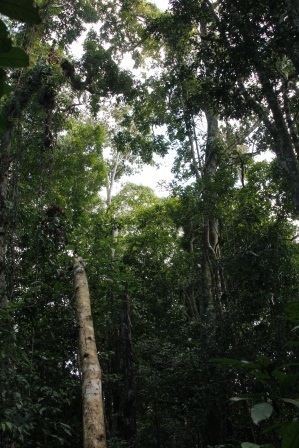
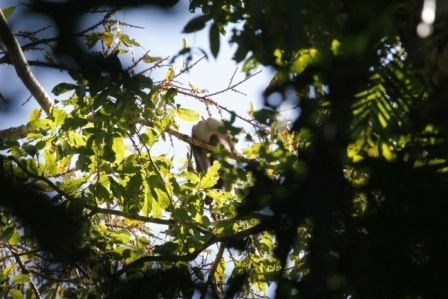
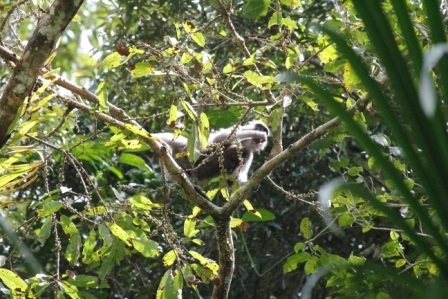
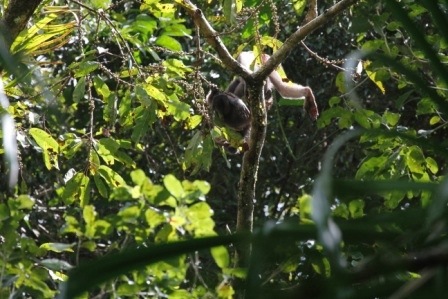
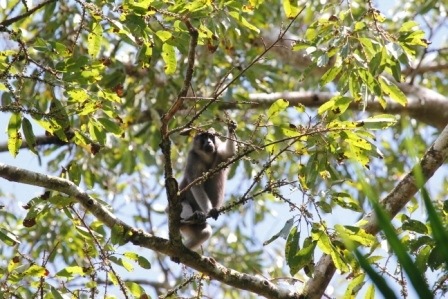
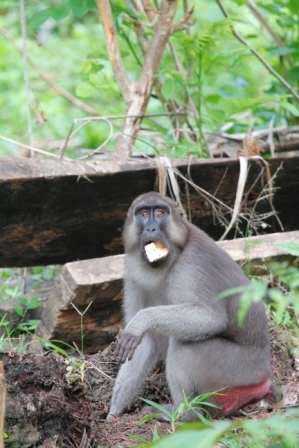
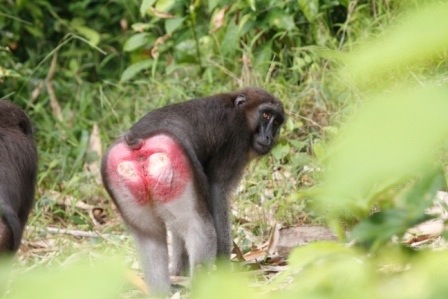
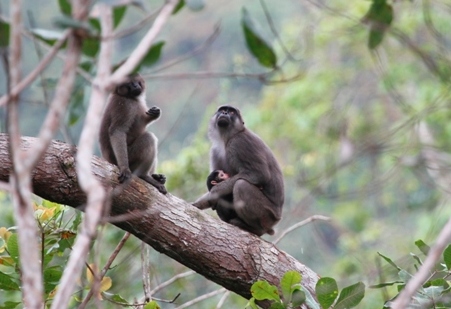
Two of the troops I study live in secondary forest or a forest-farm mosaic landscape. This means they spend quite a lot of time on the ground and I can get fairly close (within 10m). The third troop live a couple of hours into the forest – a mix of secondary and primary forest. The trees are taller here and the monkeys have little reason to come to the ground. This makes finding them and observing them that much harder!
I use two local guides an we split up to maximize our chances of finding them and we communicate with radios. That’s great when it works but the terrain is hilly so often there’s no signal. We listen for the monkeys – when they’re traveling as a group they call to one another to keep in contact. We listen for these ‘coo’ calls to locate them and the shaking of branches etc. This troop is large though so they often split up into smaller sub groups to forage for food which makes them harder to find! We also use smell – you can smell the monkeys when they’ve been through a patch of forest and we look for their poop!

With this troop the most common view (as they’re about 40m up a tree) is of their butt!

20110901-181404.jpg

20110901-181443.jpg

20110901-181413.jpg

20110901-181453.jpg

20110901-181521.jpg

20110901-181507.jpg

20110901-181549.jpg

20110901-181556.jpg

20110901-181535.jpg

20110901-181528.jpg

20110901-181625.jpg

20110901-181615.jpg

20110901-181605.jpg

20110901-181632.jpg

20110901-183430.jpg

Read Full Post »

Pet monkey

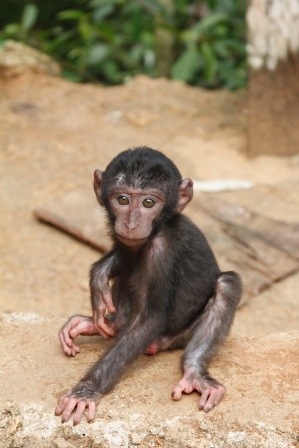
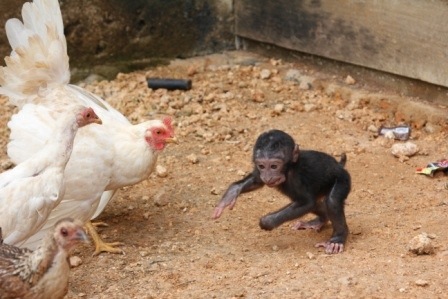
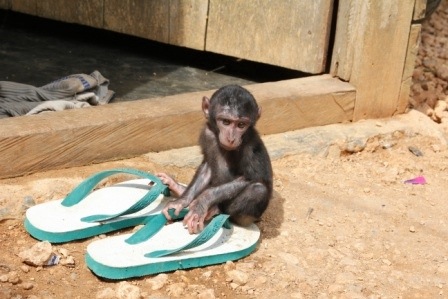
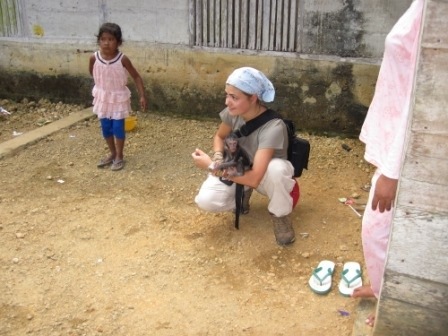
I came across this little fella yesterday. He is being kept as a pet by a family in a near by village. He’s probably about 3 weeks old and the family say they found him in the forest. Apparently they came across a troop of monkeys who were scared by them and ran off. As the troop ran off the mother dropped her infant. This does happen, especially with young infants and inexperienced mothers, but the mother would have returned for him if he’d been left. The family felt sorry for the baby monkey though and brought him home. In their defence they seem to genuinely care ft him, although their care is somewhat misguided (feeding him chocolate….). They’ve built him a cage to sleep in and let him out to run around in the daytime.

Keeping monkeys as pets is illegal, but as is so often the case in Indonesia, the law isn’t enforced. In fact it is often the police and forestry officials that tend to be the worst offenders when it comes to keeping protected species as pets!

So there’s not much that can be done now for this little guy. It’s too late to return him to his troop and the local forestry ranger won’t do anything (and even if he was confiscated there’s no where for him to go – he’d just end up in a cage behind the forestry dept office!) so all I can do is give the family sone advice about how to care for him and hope that when he gets a bit bigger he’ll run away, back to the forest. This has happened before, but sadly when they’re taken this young they usually imprint pretty strongly on their human carers so won’t run. When he gets larger he’ll become unmanageable and dangerous so he probably faces a life locked up in a small cage. Thankfully the Market for pet monkeys on this island is virtually non- existent so monkeys aren’t deliberately caught which means few have to face the fate of this poor little guy.

20110829-194747.jpg

20110829-194801.jpg

20110829-194822.jpg

20110829-194835.jpg

20110829-194847.jpg

20110829-194901.jpg

20110829-194914.jpg

20110829-194930.jpg

20110829-194944.jpg

20110829-194953.jpg

20110829-195003.jpg

20110829-195013.jpg

20110829-195033.jpg

Read Full Post »

Not all about monkeys…

These forests are not just full of monkeys, there’s plenty of other flora and fauna out here too so I thought it was about time some of the other animals got a look in.

The only other primate species on the island is the Tarsier. These are small (about the size of a clenched fist), nocturnal, insect eating primates. They live in small groups and spend their days holed up in fig trees, liana tangles or in the limestone karst rocks (which are full of holes). They come out at dusk and go off to forage, returning to their sleeping site at dawn. If you’re lucky you can see them as they leave their sleeping tree at dusk. They have a distinctive chirping call and as they leave to go foraging they call to one another. Interesting fact: one eyeball is larger than their stomach- which is why they can see so well in the dark. Imagine how big our eyes would be if they were bigger than out stomachs! They also have an elongated tarsal bone (ankle bone) which gives them their name and enables them to jump enormous distances.

Tarsier hello!

Tarsier grin

Other vertebrates in the forest include the Anoa – a critically endangered forest buffalo. It is rarely seen and in my 13 years at the field site I’ve only ever seen 2 live individuals. Sadly I’ve seen more hunted individuals.

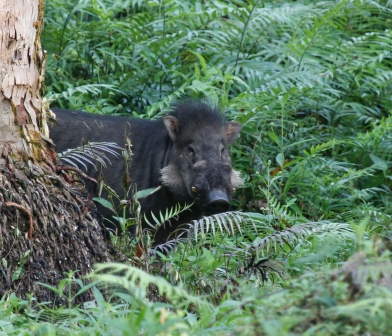
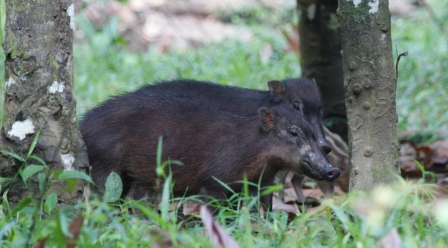
Sulawesi warty pigs are the other large vertebrate. They are also a big crop-pest – worse than the monkeys. They live in small groups and often come out into the coconut plantations and farmland. They can be quite aggressive, particularly the big males.

sulawesi warty pig - adult male

adult male peering out from behind a coconut palm

two young pigs

well camouflaged baby pigs

Other mammals in the forest include the bear cuscus – rather like a marsupial sloth, the dwarf cuscus (nocturnal and rarely seen), a host of forest rats, bats and squirrels and the introduced malay civet.

squirrel

cuscus

Read Full Post »

Poisoning

I finally managed to sit down with the farmer who poisoned the Kawelli troop of monkeys this week and interviewed him about the inicident and what led him to do it. I was pretty apprehensive about this meeting to be honest. The law is a little bit grey about the killing of monkeys when on the farms. In the forest the monkeys are protected and it’s illegal to hunt or kill them (or capture them), but once the monkeys come out into farmers’ fields they are essentially allowed to do whatever they feel they need to to protect their crops, and the rangers basically turn a blind eye to it. However people are still very nervous about admitting to anything like this.Β  It took quite a while to find out who had actually set out the poison in the farm and it’s only because I have such a strong, long term connection to the village that people were willing to tell me the truth and I was surprised that the farmer in question was willing to talk to me. In fact, he was really keen to speak to me and the interview went extremely well. He was open and honest about everything and was happy to be filmed talking about it. I deliberately conducted the interview in his farm, to make sure I didn’t disrupt his day too much but also to keep it as informal as possible. I speak fluent indonesian so didn’t use a translator which also helped to keep it informal. Had we conducted the interview in his home I am sure it would have been a very different atmosphere. As it was it was actually more like a really good chat than an interview.

La Tule (the farmer), is a subsistence farmer. He’s been farming his whole life and his farms support his family. At the moment he has a couple of farms, but only one is producing subsistence crops (maize, banana, sweet potato, papaya etc), the others are long-term plantation crops like coconut, cashew nut and cacao.Β  A few months ago his crop of bananas was just coming up to being ready for harvest,Β  but the troop of monkeys raided his farm every day and pretty much decimated the crop. This is what pushed him over the edge and led him to buy an extremely powerful vertebrate poison known locally as “Temix”. This was no easy decision – this poison cost him 250,000 rp for half an ounce (Β£20) which, for a farmer here, is several months income but the loss of his banana crop was too much for him to bear. Unlike other crops bananas are currently fetching a reasonable price at the local market. The money he gets from selling some of his bananas is used to send his children to school and to buy rice etc to eat. Monkeys raid other crops too, like papaya and maize, but these don’t fetch good prices at market and as long as there is some left for him and his family to eat he doesn’t mind the loss as much. The only way to prevent the monkeys damaging his bananas is to guard the farm all day, every day. But he also has to guard the farm all night as well, to prevent the wild pigs raiding, so aside from being exhausted, it also means he can’t use the days to try to find odd jobs and other work elsewhere, or tend to his other farms. So he took the decision to gather as much cash as he could and buy the poison. He laced bananas with it and laid them out in the farm. As usual, the monkeys came to raid the farm and took the poisoned bananas, within an hour 19 individuals were dead.

The last time poison was used on the monkeys in this village was around 2002, by the same farmer. Why had he used it then? The same reason as now – because the monkeys were destroying his banana crop. Why hadn’t he used it at all since 2002? Well, it’s fairly simple – he hadn’t been growing bananas since then! Asked if he would use poison again he said he definitely would – if he had the money, and if he was growing bananas. So that’s not a great outlook for the monkeys!

Interestingly though he isn’t bothered so much about the monkeys taking other crops, and in fact he told me that he is happy when they come and take the cashew nut fruits because they only eat the fruit, dropping the nuts to the ground and leaving them.Β  As long as he has cleared his farm of grass and weeds he can then come and collect the nuts easily from the ground without having to climb the tree – so he welcomes the monkeys during the cashew season.

This is one of the things that makes this research site so interesting – we have a pretty major human-wildlife conflict. We have a threatened species of monkey whose habitat is rapidly dimishing, being forced to come out into farmers’ fields to get enough food. Yet we also have local farmers with nothing but their farms to sustain them and provide for them and their children and with monkeys stealing up to 90% of farmers’ crops, leaving farmers having to guard their farms all day to scare the monkeys away who can blame them for occasionally losing the plot and resorting to poison? But what is so interesting and provides so much hope and potential for the conservation of this species is that these incidences of lethal deterrence are so rare and there’s actually a huge degree of tolerance here. It’s that tolerance that needs to be fostered, along with control of the habitat destruction, in order to provide a future both for the monkeys and the local people.
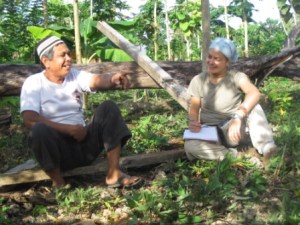
Interviewing La Tule in his farm
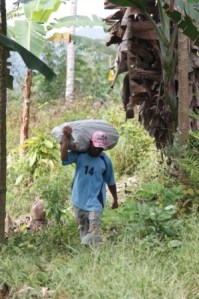
Carrying out some of the banana crop to take it to market
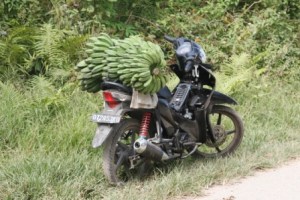
Loading up the bike to take the bananas to market

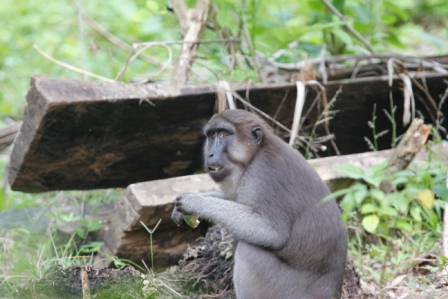
A monkey eating a stolen banana in the farm

Monkey with a mouthful of banana!


Read Full Post »

No monkeys!

The small troop of monkeys have been hard to follow lately. With only 6 individuals they move quietly and are much harder to spot. This morning we’ve just spent 3 hours trying to find them. Finally we found one – a young female, feeding in a kapok tree but she grabbed 3 kapok fruits and ran off into some really overgrown bush and we lost her again. They’ve not raided crops in the farms for days and they’re hungry so they’ve split up and are foraging alone or in pairs and only coming back together to rest or to the sleeping tree at night. It looks like at least 2 of the female are pregnant so fingers crossed this troop should start to increase in numbers again soon. Meanwhile we’ll just have to keep searching for them!

20110815-084152.jpg

Read Full Post »

Honey collecting

I’ve spent the last couple of days in the forest with some local guys from the village of Watambo collecting honey with them.

Local people go into the forests to harvest honey from the wild Giant Honey Bee (Apis dorsata). The bees make large hanging honey-comb nests and then roost on the outside of the comb so all you see is a mass of moving bees hanging from the branches. They only select certain branches at specific heights, angles and light levels and will often return to them year after year if harvested carefully. Local honey collectors have their own trees which they mark so others know not to harvest from them and can harvest up to twice a year from one colony. Many of the nests are located deep in the forest though so require quite a trek to get to them. Once they find a nest that’s ready to harvest they prepare a bamboo smoker using old dead bamboo which they split and wrap around a smaller bamboo within which they carve a hole to hold the dried bits of leaf and fibre used to start the fire and create smoke. They then wrap this in leaves which are tied tightly. The whole smoker is attached to a bamboo pole and tied to some bark rope to be hauled up in to the tree. After about 5 hours trekking we found a bee’s nest on the first day, but sadly it had no honey. So we tried again the next day and after another long trek we found a nest with honey. The two collectors – Jahu and La Didi, made up a smoker and then Jahu climbed up about 30m into the tree and hauled the lit smoker up to him.Using the bamboo pole he manouvered it under the nest and then waited for the smoke to make the bee’s leave the honeycomb.

After about 20 mins and a lot of angry bees the honey comb was revealed and La didi climbed right up 40m into the canopy and hauled up a bucket to collect the honey comb. He lowered it back down to Jahu and thankfully we had some honey! The honey is extracted by hand (by squeezing the comb) and put into a jerrycan. It’s usually transferred to litre or half litre bottles and then sold at he side of the road – currently it’s about 80,000rp for a bottle (twice last year’s price).Β  It’s a really important, and sustainable, forest resource for local peopleΒ and it is divine!


Read Full Post »

More woods!

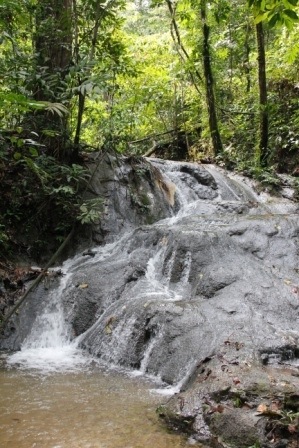
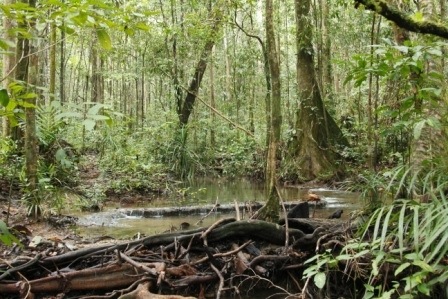
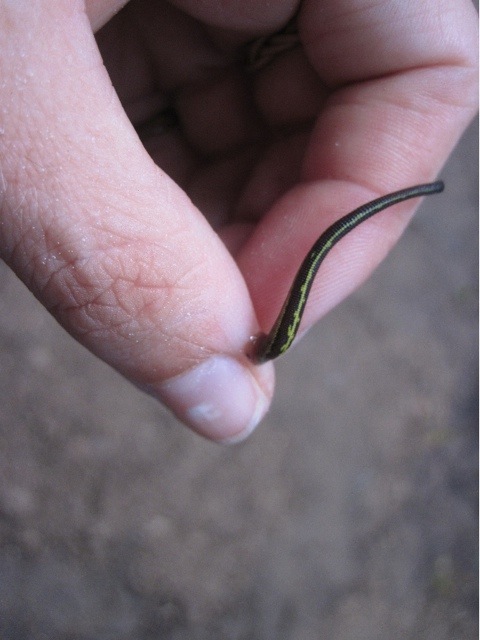
I’ve been on another big jungle trek again – back up to that new area of forest. It’s such a beautiful bit of forest so I just couldn’t resist going back there we’ve had a lot of rain recently so the the conditions were slippery to say the least and it was leechtastic! But I don’t really mind the leeches – they’re really rather beautiful and very cool the way they hang on on leaves waiting for passing mammals! Also saw a snake, monitor lizard, an footprint (endemic dwarf buffalo – very rare!) and some monkeys. The monkeys were about 40m up in the canopy – a big adult male and a sub-adult. Very skittish though and didn’t hang around for long. We walked up to ‘bukit senyum’ – smile mountain, which had a pretty good view over the forest – breathtaking πŸ™‚

20110805-152834.jpg

20110805-152815.jpg

20110805-152735.jpg

20110805-152851.jpg

20110805-152925.jpg

20110805-152910.jpg

20110805-152759.jpg

Read Full Post »

Baby monkey

Great news!

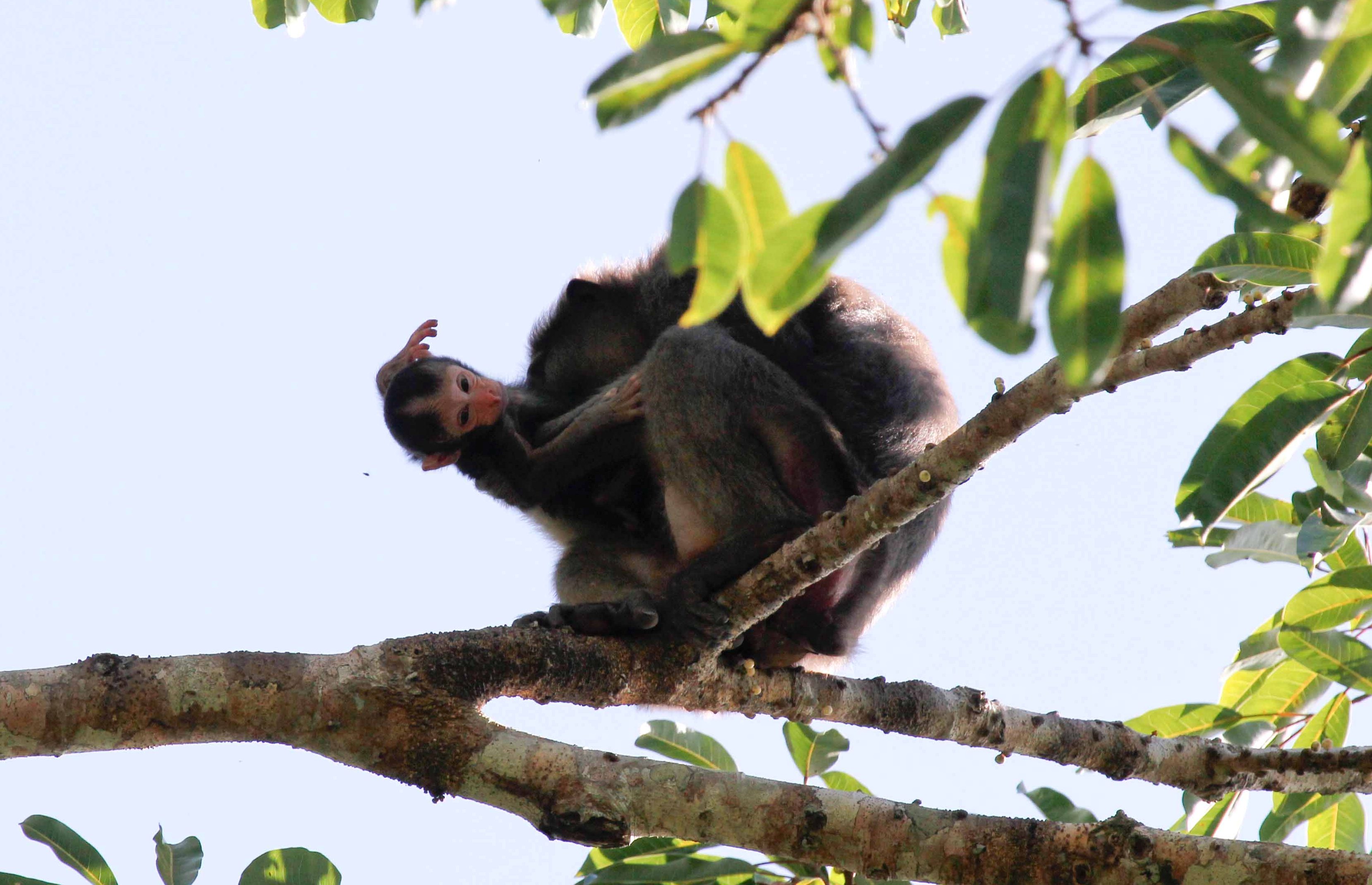
Last week whilst following one of the other troops of monkeys I discovered that a new baby had been born into the troop. This troop live primarily in the Kakenauwe Nature reserve which is a small area of forest bordered by farms, plantations, villages and the road. Their range encompasses the whole of the reserve which is approximately 810 hectares big and although they still have fruit trees to feed on it’s a pretty small area now as the edges have been eaten away with farms and plantations. So they often come out in the farms to forage for food. In the past this troop has been really large, over 45 individuals and usually there are plenty of infants at this time of year. This year however the group seems to have split up into 2 smaller groups and we’re left with only about 26 monkeys and until now there were no infants. The arrival of this little one is really exciting and a great sign for this troop after the splitΒ  πŸ™‚

Mum checking the little guy over


Read Full Post »

Since my last update I’ve been spending time with the monkeys. I went out last week to the village of Kawelli to find the troop of monkeys that suffered from the poisoning.

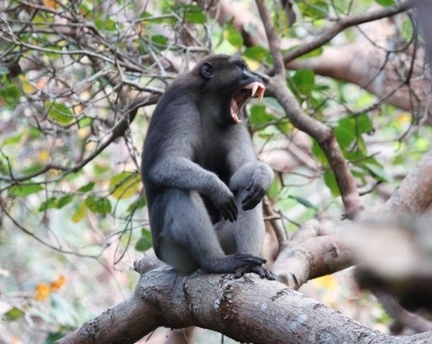
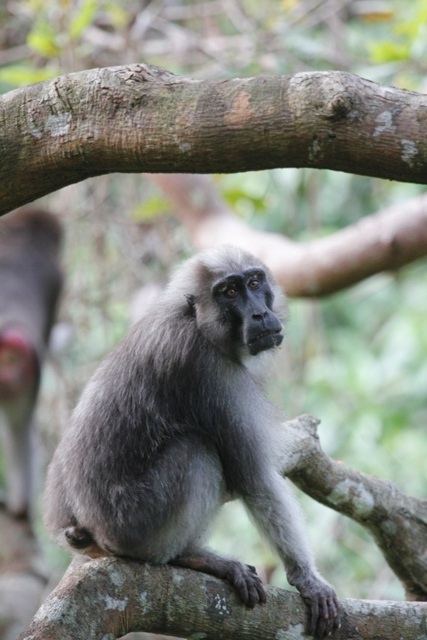
This troop of monkeys which consisted of 25 individuals originally, lives in a forest-farm mosaic near the village. Their home range consists of few small forest refuges, overgrown farms and active farms and plantations. Over the 12 years I’ve studied them the forest refuges have got smaller and the farms more plentiful. The monkeys still need to eat though so as a result they’ve become more and more reliant on crops to sustain them. Farmers in this area rely almost totally on their farms for food. Farms are small (usually under a hectare) and are planted with a mix of crops – fruit and vegetables such as maize, sweet potato, banana, papaya etc. A few months ago one of the farmers got fed up with the monkeys stealing all his bananas so he bought some poison and laid put poisoned bananas for them. 19 members of the troop were killed leaving only 2 adult males and 4 adult females. One of the adult males is pretty old and in lieu of the dominant male of the troop the young male has started to take on that role. As a result he’s bulked up and has become more aggressive as he asserts his authority over the other 5 monkeys.

Since the poisoning the monkeys have become slightly warier but they still rid farms an we’re still able to follow them and study their behaviour. We’ve seen lots of mating and at least 2 of the females look to be pregnant so there’s hope for this little troop yet. They’ve also come in to contact with a neighbouring troop. So far it’s mostly involved lots of shouting and scrapping but there’s a chance they may join that troop.

I’m hoping to have a good chat with he farmer involved soon to understand a bit more about what pushed him over the edge this time and led to him poisoning them (the poison is incredibly expensive so it wasn’t a decision taken lightly). Watch this space for more updates!

Young male showing off

20110727-154155.jpg

Old male

20110727-154213.jpg

Read Full Post »

« Newer Posts - Older Posts »

Every Step Fitness

With you every step of the way

Travel Gourmet

Travel tips-Restaurant reviews-Recipes

The Holistic Ingredient

One woman's take on whole foods, clean living and boundless energy.

eggton

{salty wit + a sweet tooth}

Wuthering Bites

Simple Gluten Free recipes for any time of day.

ww123

wildernesswalking123

tillysmarathon

This WordPress.com site is the bee's knees